Job searching, especially for fresh graduates, can be overwhelming due to competition, but with the right approach and mindset, you can succeed.
Here are:
Know Yourself
Before you start applying for jobs, it’s crucial to take some time to understand yourself.

Assess Your Skills and Interests
- Identify Your Strengths and Weaknesses:
- Make a list of what you’re good at and what you enjoy doing.
- This can include technical skills like coding or graphic design, as well as soft skills like communication or teamwork.
- Evaluate Your Experiences:
- Think about past experiences, such as internships, volunteer work, or projects you completed during your studies.
- Identify the skills you used and the tasks you enjoyed the most.
Set Clear Career Goals
- Define Your Goals:
- Ask yourself what you want to achieve in your career.
- Do you want to work in a specific industry or role?
- Are there particular companies you admire?
- Ask yourself what you want to achieve in your career.
- Consider Your Ideal Work Environment:
- Think about the type of work culture you thrive in.
- Do you prefer a structured environment, or do you excel in more flexible settings?
- Understanding this can help you find a job that matches your preferences and working style.
- Think about the type of work culture you thrive in.
By knowing yourself and what you’re looking for, you can target your job search more effectively and apply for roles that align with your skills and interests.
Research the Job Market
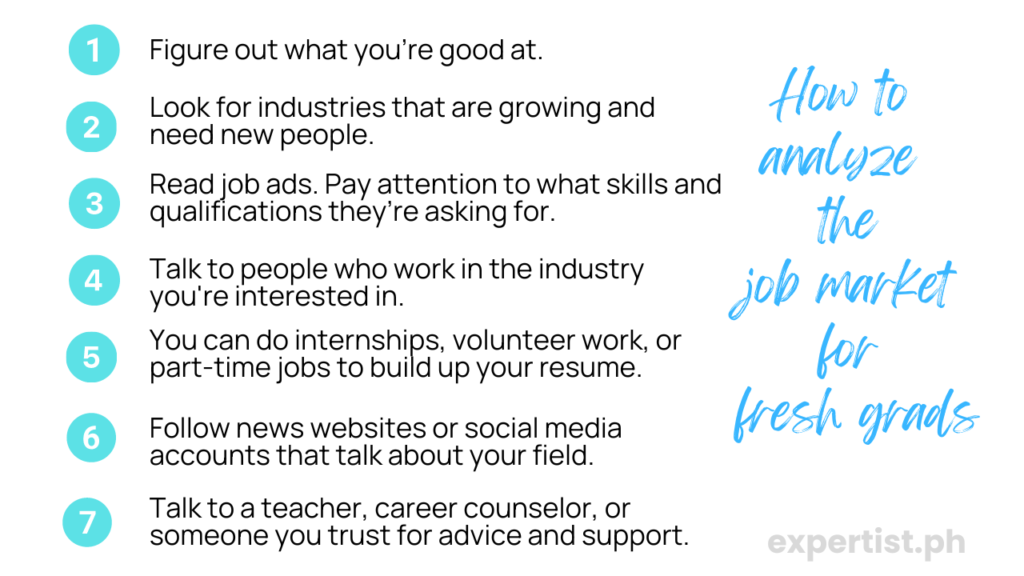
Understanding the job market is a crucial step in your job search.
Knowing where to look and what to expect can help you find opportunities that are a good match for your skills and goals.
Understand Industry Trends
- Research Job Demand:
- Look into the current demand for jobs in your chosen field.
- Some industries may have more openings and growth potential than others.
- Websites like LinkedIn, Indeed, and Glassdoor can provide insights into job trends and hiring patterns.
- Identify Growing Industries:
- Pay attention to industries that are expanding and have a high demand for new talent.
- For example, technology, healthcare, and renewable energy are sectors that often offer numerous opportunities for fresh graduates.
Identify Potential Employers
- Make a List of Target Companies:
- Create a list of companies that align with your career goals and values.
- Consider factors such as company size, location, and culture.
- Research Company Information:
- Learn as much as you can about these companies.
- Visit their websites to understand their mission, values, and recent developments.
- Follow them on social media to stay updated on their news and job postings.
By thoroughly researching the job market, you can gain a better understanding of where your skills are needed and what employers are looking for.
Prepare and Apply Strategically
Once you have a clear understanding of yourself and the job market, it’s time to prepare yourself for the application process.
This involves crafting strong application materials and applying for jobs strategically.
Craft a Strong Resume and Cover Letter
- Customize Your Resume:
- Tailor your resume to each job application by highlighting relevant skills, experiences, and achievements.
- Use keywords from the job description to demonstrate your fit for the role.
- Write a Compelling Cover Letter:
- Your cover letter should complement your resume by providing additional context and showcasing your enthusiasm for the position.
- Address the hiring manager by name if possible and explain why you’re interested in the role and how your skills make you a good fit.
Leverage Networking
- Utilize LinkedIn:
- Create a professional LinkedIn profile and connect with industry professionals, alumni, and recruiters.
- Join relevant groups and participate in discussions to expand your network.
- Attend Networking Events:
- Look for job fairs, industry events, and networking mixers in your area.
- These events provide opportunities to meet employers face-to-face and learn about job openings.
Prepare for Interviews
- Research the Company:
- Before your interview, research the company thoroughly.
- Understand their products, services, and mission statement.
- Familiarize yourself with recent news and developments.
- Practice Interview Questions:
- Prepare responses to common interview questions, such as:
- “Tell me about yourself”
- “Why do you want to work here?”
- Practice with a friend or family member to gain confidence and polish your answers.
- Prepare responses to common interview questions, such as:
By preparing and applying strategically, you can increase your chances of landing interviews and ultimately securing a job offer.
Remember to stay organized, keep track of your applications, and follow up with employers after interviews to demonstrate your continued interest in the position.
Conclusion
Finding the right job can take time and effort, so don’t feel down if you don’t succeed right away. Keep trying, improve your skills and job applications, and connect with people in your field.
Most importantly, stick to what matters to you and your career goals. Don’t settle for a job that doesn’t match your values or dreams. Believe in yourself and keep going until you find the perfect fit.
Disclaimer
The information provided in this article is intended for educational purposes only. While every effort has been made to ensure the accuracy and completeness of the content, job market conditions and hiring practices may vary over time and in different regions.
References
- Bureau of Labor Statistics. (n.d.). Occupational Outlook Handbook. Retrieved from https://www.bls.gov/ooh/
- Indeed. (n.d.). Job Search Website. Retrieved from https://www.indeed.com/
- Glassdoor. (n.d.). Company Reviews & Ratings. Retrieved from https://www.glassdoor.com/
- LinkedIn. (n.d.). Professional Networking Site. Retrieved from https://www.linkedin.com/
- CareerBuilder. (n.d.). Job Search Website. Retrieved from https://www.careerbuilder.com/
- Monster. (n.d.). Job Search Website. Retrieved from https://www.monster.com/
- The Muse. (n.d.). Career Advice & Company Reviews. Retrieved from https://www.themuse.com/
- Forbes. (n.d.). Business News and Financial News. Retrieved from https://www.forbes.com/
- Harvard Business Review. (n.d.). Management Magazine. Retrieved from https://hbr.org/
- Fast Company. (n.d.). Business News and Innovation. Retrieved from https://www.fastcompany.com/
- Society for Human Resource Management (SHRM). (n.d.). HR Professional Organization. Retrieved from https://www.shrm.org/
- U.S. News & World Report. (n.d.). News & Rankings. Retrieved from https://www.usnews.com/
- CNBC. (n.d.). Financial News. Retrieved from https://www.cnbc.com/
- The Balance Careers. (n.d.). Career Advice & Financial News. Retrieved from https://www.thebalancecareers.com/
- Vault. (n.d.). Career Intelligence. Retrieved from https://www.vault.com/
- National Association of Colleges and Employers (NACE). (n.d.). Career Development and Employment Resources. Retrieved from https://www.naceweb.org/
- Career Contessa. (n.d.). Career Advice for Women. Retrieved from https://www.careercontessa.com/
- ZipRecruiter. (n.d.). Job Search Website. Retrieved from https://www.ziprecruiter.com/
- FlexJobs. (n.d.). Remote Jobs, Part-Time Jobs, Freelance Jobs. Retrieved from https://www.flexjobs.com/
- Indeed Career Guide. (n.d.). Career Development and Job Search Advice. Retrieved from https://www.indeed.com/career-advice